
I’ve already noted that we’re all bags of bitchy, demanding enzymes.
Physiologically, over short timescales of our day-to-day behaviors, this holds true as our efforts to maintain a constant body temperature, ensure we have just the right concentration of salts in our blood, and eat food are all efforts to please the angry hordes of enzymes within us who can only operate happily in a particular range of environmental conditions.
On longer timescales, there are curious threads in the story of life such as the ocean bacterial cooties you got from your mom. When we’re flexible with the evolutionary scales at which we zoom in or zoom out of life, there many rich stories about who we are. At the finest scale, you are you, a walking swirl of sentient atomic stardust. At the scale of genera, we are hominids (Homo) who live in tribes. We are mammals (Mammalia) who nurse our young with milk, Tetrapods (Tetrapoda) who crawled onto land with lungs and limbs, vertebrates (Chordata) with bones, animals (Animalia) that move, and even Eukaryotes (Eukarya) that have membrane-bound sacks inside our cells along with mitochondria, the ocean bacterial cooties we got from our mom.
Today, I want to zoom out even more.
In this blog, A Biologist’s Guide to Life, my goal is to view this curious thing called life from many angles not necessarily to answer any philosophical questions about how to live a good life, but to show you the empirical and theoretical landscape of life so you can navigate those questions on your own.
In rambling journey of a post (A Biologist’s Guide to Information), we toured past some of the basic mathematics of life, namely that the core definitions of life, the axioms we use to define living, all require self-replication.
Eigenthings and The Mathematics of Replication
Replication is a curious pattern in nature. Replication is slightly different from repetition. Waves in the ocean repeat a particular form of crashing wave at semi-regular intervals on the shore; some clouds show patterns of repetition in bands akin to the repeated waves in the sea or checkerboards akin to two wave fronts crossing paths.
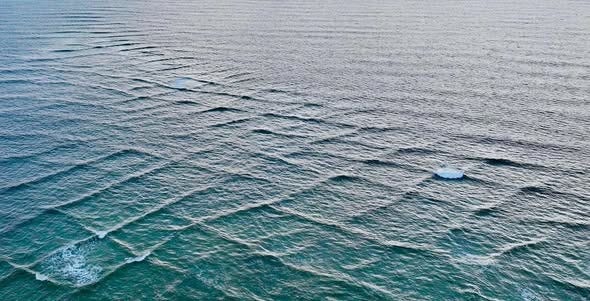
To understand replication at the heart of life, it helps to start with repetition. Let’s take a brief look at the mathematics of repetition.
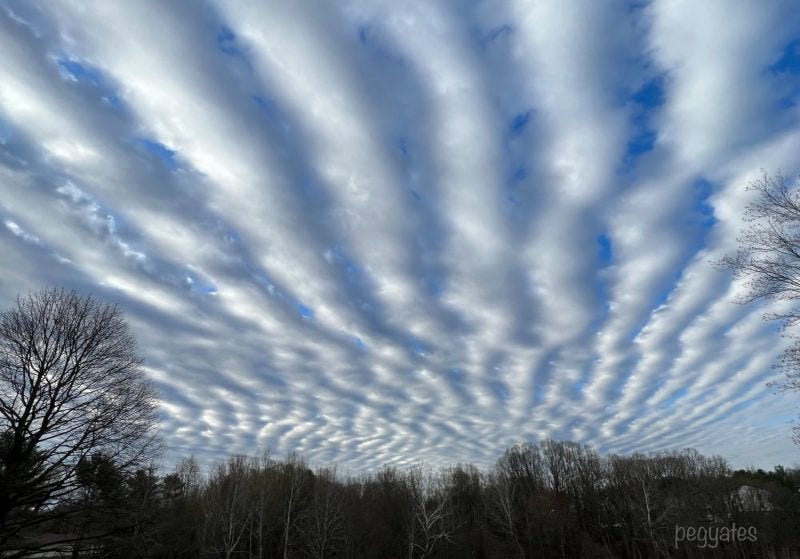
For waves, for example, we can study their dynamics with a mathematical equation called the wave equation. Bear with me as we do some math - I’ll try to be clear (please provide feedback if anything is unclear!) and minimal while still touring you along the actual mathematics that informs what living things truly are. As usual, hold the reigns loosely for this mathematical journey, view these symbols as one might view a giraffe on safari - curious things who we need not understand in full to appreciate, but which the tour guide will hopefully explain in some enriching detail.
Why does the world have waves? Imagine what the ocean could be - it could be any chaotic surface of water, yet somehow the water organizes itself into regular patterns rising and falling. Why?
Waves come about most naturally in mathematics in the wave equation. The wave equation defines how the position of some surface, such as the surface of the ocean or the surface of a drum, changes over time given some initial conditions. The rate at which some function f changes over time is called in mathematics “the partial derivative with respect to time”, denoted:
and the rate at which the rate above changes is denoted
The surface of the ocean can be described with some function of space x that changes over time, t, which we’ll denote f(x,t). As we can use partial derivatives above to describe functions changing over time, we can also use partial derivatives to describe how functions change over space by replacing the t in the equations above with the variable for space, x. The string of a guitar, for example, can be seen as one wiggly function whose movement approximately follows the equation below:
Don’t sweat trying to understand exactly why this equation is such a good approximation for the wavey wiggles of a guitar string, just notice the familiar second partial derivatives with time and space are curiously connected by some constant, c.
Mathematicians solve this equation by noticing (through math we don’t need to prove here but just trust me) that there are many solutions and the function f can be written as sum of these many solutions. To solve this equation, we just need to find these separable, smaller solutions and then sum them to find a more general function, f, which solves these equations.
Actually solving this equation is the work of fairly advanced mathematics courses called partial differential equations or PDEs. Thus, we won’t actually, formally solve this equation here, but that doesn’t mean we can’t leap-frog through years of mathematical study to observe some beautiful intuition about PDEs.
We often solve PDEs by finding solutions of a peculiar form such as:
where λ is another constant number. The equation above says that the rate at which the rate of f changes over time is proportional to the function f itself.
Semantically, we can see some repetition here: there are some curious functions where taking the derivative of the function returns the function itself. More generally, mathematics is full of operations, from derivatives to operations that take a function and stretch it, shrink it, rotate it, and more, and for any weird operation there can be functions that are preserved. Sometimes the functions preserved by an operation tell us peculiar things about the operations, and likewise any given operation can work beautifully when operating on peculiar functions.
To intuit this connection between operations and their preserved functions, take the rotation operation: a circle is a function that is preserved with rotation about the center of the circle. In 3D, the function that is preserved with rotation is the sphere. Now instead of starting with a circle, take a piece of paper and draw any wiggly surface you want. Then, pick an arbitrary point on the page, hold that point down with a pencil, and spin the page. Spin the page faster, as if it were spinning forever and you could see all the functions at the same time, what do you get?
You get a circle. Your circle might actually be a thick circle as your continuous wiggly function spins about an axis to span many circles, each point spanning its own circle. Yet, it is circles. Rotations give you circles, and circles are preserved under rotations.
Mathematics have a name for these peculiar functions preserved under an operation:
Eigenfunctions.
Going back to the wave equation, there are two peculiar functions that are preserved under the operation of second derivatives: exponentials and sines/cosines. Exponentials either explode to infinity or decay to zero whereas sines and cosines are… waves.
Solutions to the wave equation, especially with some forces that dampen the string (so the guitar doesn’t wiggle forever) look like exponentials dampening the waves of sines and cosines.
In other words, the solutions to the wave equation are eigenfunctions of the operators therein.
Eigenfunctions and eigenvectors and other eigenthings are mathematical curiosities one tends to not fully appreciate until getting a PhD in mathematics. The word “eigen” is a German word meaning “own”, “self”, or “characteristic”. A function that passes through an operation and maps to its-self is an eigen-function.
Eigenthings are one of the most mathematically elegant examples of repetition. That eigenfunctions like sines and cosines are solutions for the wave equation provides intuition for how the laws of the universe - a curious set of operations defining how matter interacts - have a complementary set of things which repeat themselves. As we showed with the weird wiggly function on a page spun about an axis and how it turns into a fuzzy circle, repeating operations again and again and again (or quickly for a long period of time) tend to make whatever weird thing we started with converge to some self-replicating thing such as the circle for rotation, waves for the forces of tension in a guitar string or surface of the ocean, and more.
Life as Eigenthings
The laws of the universe can be viewed as a complex set of operations.
Newtons laws, for example, tell us how billiard balls will collide and conserve momentum (“with every action there is an equal and opposite reaction”), or how gravity accelerates objects (i.e. an object suspended in space will see the partial derivative of its velocity equal to a positive constant - the gravitational constant for Earth). The math equation above connecting the second derivative of a function to itself is like Hook’s law where the force (i.e. acceleration by Netwon’s F=ma law) from a string is proportional to its displacement (i.e. position, f). Newton’s laws define operations, and operations lend themselves to the solutions we see in nature.
When atoms interact, the laws of the universe define these interactions in an almost computational way: if CO2, H2O, and the energy from light meet a peculiar enzyme in plants, a complex series of operations results in glucose and oxygen. If glucose and oxygen meet enzymes in our cells, it will be broken down into CO2, H2O, and energy. Chemical laws define what goes in and what comes out of chemical reactions, at which rates, in which conditions, and thereby define operations with the solutions we see in nature.
Nearly 4 billion years ago, the Earth was a giant ball of atoms interacting with one-another according to these laws, these operations of the universe. Like the page turning your wiggly function into a circle, the repeated operation of these atoms eventually converged on a peculiar solution of self-replicating molecules. Today, we believe these early self-replicating molecules were sequences of nucleic acids as the complementarity of sequences of nucleic acids (A’s binding to T’s, G’s binding to C’s) allows a string of nucleic acids, through some complex set of operations in a similarly complex environment, to copy itself indirectly. The sequence ATGC first copies itself to the sequence TACG… and then TACG copies itself to ATGC. We started with just one ATGC and, through a complex set of operations, now we have two.
It’s not unreasonable, then, to see the self-replication of life as a curious connection between life as an “eigenthing” of the universe and the laws or operations of the universe whose specific chemical environment may vary from planet to planet. While the mathematics of these operations are too complex for any human to describe today, the solutions stand before us as surely as the waves that repeatedly lap upon the shore.
This doesn’t mean that life will always arise on planets. The variable initial conditions of planets may make it improbable for life to form in the planets’ lifetime, let alone for life to sustain itself. Waves do not form in rocks (although they do form in sand, thanks to operations of the fluid-like wind). The nucleic acids replicating in primordial ooze required other nucleic acids before they could catch fire and replicate. You could try to spin the page of life on Pluto, figuratively speaking, and the page would break because it’s too cold or too distant from the sun or too unlucky in the chance formation of this planet to have the right chemicals required for the page to spin and a circle to form.
It may seem like a stretch to leap from a wave equation’s eigenfunctions to life forms as eigenthings, but there’s a stepping stone of intermediate complexity that I just love: Langton’s Ant.
Langton’s ant is a computer model in a grid with a very simple set of laws/operations. First, go forward. Then, if the ant lands on a white square, turn the square grey and turn left. If the ant lands on a grey square, turn the square white and turn left. Below is a simulation of Langton’s ant.
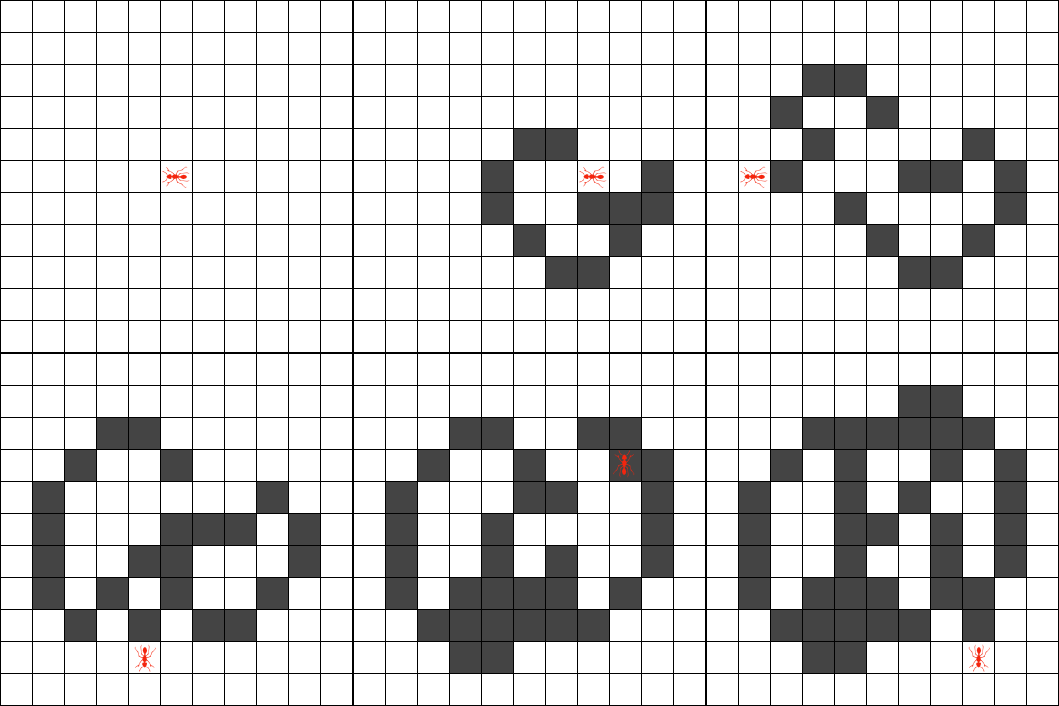
At first, Langton’s ant shows the kind of weird, unpredictable long-term pattern as we might imagine in the primordial ooze. However, if you run this simulation for a long time, a strange pattern emerges. Watch the video below:
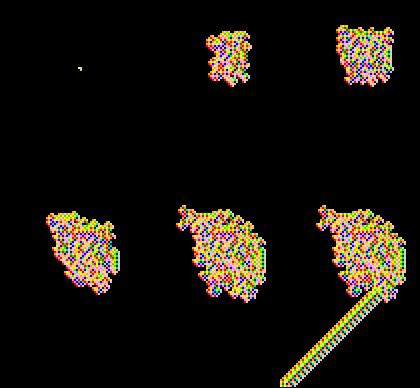
This strange universe of laws defining Langton’s ant may start off irregular and unpredictable, yet over time it converges on a pattern that repeats itself, an eigenpath of the ant if you will. There exists some strange set of arrangements in the environment around the ant combined with the starting point of the ant such that the pattern will repeat its-self over time.
There is something deeply curious about the mathematics of replication that this same concept of eigenthings can appear across very different operations, that repeated operations can often converge to these fixed patterns, points, or eigen things. On the other hand… perhaps there’s some very simple intuition.
Insofar as the input to the world’s operations is a mixed bag operating in a somewhat parallel fashion (e.g. atoms in one location interact in a way that isn’t affected by the interactions of atoms far away), then whenever a self-replicating thing arises, it produces more of itself, and these copies of themselves produce more of themselves still, and so on until eventually the most common thing we see are these self-replicating things. The ocean has many irregular ripples and spewing drops, but these irregularities don’t repeat, they don’t replicate, and thus they don’t define the more common surface of waves on the ocean.
Life replicates itself in a manner analogous to Langton’s ant. We don’t self-replicate in siloes in space, but rather in an environment full of foods we interact with, structures we build, and tools we make. Through some complex Langton-ant-like way, we go about our lives grabbing food & changing it to biomass, energy and poo… we grab tools and change them into social value (money, friendships, dates, jobs)… we grab resources and convert them into structures like homes and beds… and through this complex set of operations with our environment we often produce new human beings similar to ourselves.
We don’t give birth to elephants or amoebas, but humans. Elephants go about their lives obeying some ecological laws, interacting with some heterogeneous Langton-ant-esque environment, and begetting more elephants. That life begets life, living things self-replicated in the image of the living thing before it, makes life seem almost inevitable in the universe… provided the right environment exists for these operations which turn the page, figuratively speaking.
You are not just a bag of bitchy demanding enzymes… enzymes which are eigenthings from a bygone era of smaller-scale life in which nucleic acids and enzymes ruled the world. You are not just a multicellular mass infected with ocean bacterial cooties… ocean bacterial cooties / mitochondria from a bygone era of ocean bacterial things infiltrating cells to beget ocean bacterial things infiltrating cells. You are not just a tetrapod that crawled onto land to beget other tetrapods crawling on land, breathing oxygen with lungs, and eating food on land and in the sea to beget more tetrapods. In the long arc of life, zooming out as far as we can in the operations of the universe and zooming in as close as we can to you being you…
You are an eigenthing.
You are the next self-replicating pattern in a long chain of self-replicating patterns before you. Every single ancestor since the dawn of life has gone through some Langton-ant-esque process to self-replicate, and by good fortune we find ourselves existing today thanks to the wave fronts we represent having been lucky enough to never go extinct, our Langton ant ancestors having never been stepped on, wiped off the map by meteors, outcompeted by competitors, or experienced other manners of extinction.
You a modern front in a vast ocean of waves of life, an eigenthing of the complex operations of the universe.
Epilogue
I first brewed, mulled on, and in many ways was influenced to see life as an eigenthing thanks to conversations with Alex Lamb at Princeton. Alex Lamb is a computer scientist, one of the most brilliant people I’ve ever met, and he considered the universe as computer-like, guided by computational principles and operations, and shaped by the mathematical inevitabilities of these operations. He wrote some of his most far-out thoughts in The Roboteer Trilogy, a sci-fi space opera about humans self-modifying with robots to create higher scales of competition, battles of evolution that start out within a species until selection favors higher orders of self-replicating things competing against one-another on a galactic, intergalactic, and universal scale.
When you read Roboteer, it feels like finally reading the mind that created The Matrix, as if Alex Lamb wrote The Matrix and the rest of us were unfortunate to receive this information only second-hand. Here today, I repeat/self-replicate the information brewed from interactions with Alex Lamb somewhat second-hand, so feel free to check out The Roboteer for a plugin to a truly original mind.
Thank you very much for this post. I learned the concepts of eigenvectors and eigenvalues in high school, but I did not figure out why they were useful until I got into graduate school. And I did not know the concept of an eigenfunction until reading your article. I think more can be elaborated on about this subject by the author in some other articles. Best Regards.